
Colorado Cycling and E-bike Law FAQ
10 questions about riding in Colorado: the e-bike rules, the roads and trails worth the trip, the season, and the events.
Questions and answers
What are the e-bike laws in Colorado?
Colorado classes e-bikes as bicycles rather than motor vehicles, so Class 1, Class 2, and Class 3 ride with no license, registration, or insurance. The three classes date to Colorado HB17-1151, and Colorado HB25-1197 added lithium-ion battery certification, an exclusion for bikes built to switch out of class, and a ban on false labeling, effective August 6, 2025.
Does Colorado really pay you to buy an e-bike?
Yes, twice over in 2026: every Coloradan gets a $225 discount at the register through the state tax credit, and the Colorado Energy Office relaunched its income-qualified rebate in August 2026 with $3 million, worth $1,000 toward an e-bike plus $300 more for a cargo or adaptive model, through lottery windows in August, October, January, and March. One thing to watch: a bike built to be easily switched past its class limits is not an e-bike under Colorado HB25-1197, and selling it as one is a deceptive trade practice.
Who has to wear a helmet on an e-bike in Colorado?
Adults on Class 1 (pedal assist to 20 mph) and Class 2 (assist with or without pedaling to 20 mph) ride without a state helmet rule. Class 3 (pedal assist to 28 mph) is different: operators and passengers under 18 wear a CPSC- or ASTM-certified helmet (CRS 42-4-1412), and riders under 16 may not operate a Class 3 at all, though they may be passengers.
Where can I ride a Class 1, Class 2, or Class 3 e-bike in Colorado?
Every class has full bicycle rights on roads and bike lanes (CRS 42-4-1412). Class 1 and Class 2 may use bike and pedestrian paths wherever bicycles are authorized, with a local opt-out, and Colorado Parks and Wildlife opens its multi-use trails to them; Class 3 is limited to paths that run within a street or that a local authority approves, and to park roads and bike lanes in state parks. Sidewalks are open with pedestrian duties unless a city says otherwise, and Denver and several others do.
What is the Colorado Safety Stop?
Since 2022, riders 15 and older, and younger riders with an adult, may slow and treat a stop sign as a yield sign and stop and treat a red light as a stop sign when the way is clear (CRS 42-4-1412.5). Local authorities may opt out, so posted signs win. Drivers owe cyclists 3 feet when passing (CRS 42-4-1003) and may cross a double yellow line to give it.
What is the best high-mountain road ride in Colorado?
Trail Ridge Road through Rocky Mountain National Park tops out at 12,183 feet, the highest continuous paved road in the country, and the climb from Estes Park is the state's signature ascent. Independence Pass out of Aspen, Mount Blue Sky (formerly Mount Evans) at 14,130 feet, Loveland Pass, and Monarch Pass round out the list; all open to bikes when the snow clears, usually late May or June.
Where are the best rides near Denver, Boulder, and Colorado Springs?
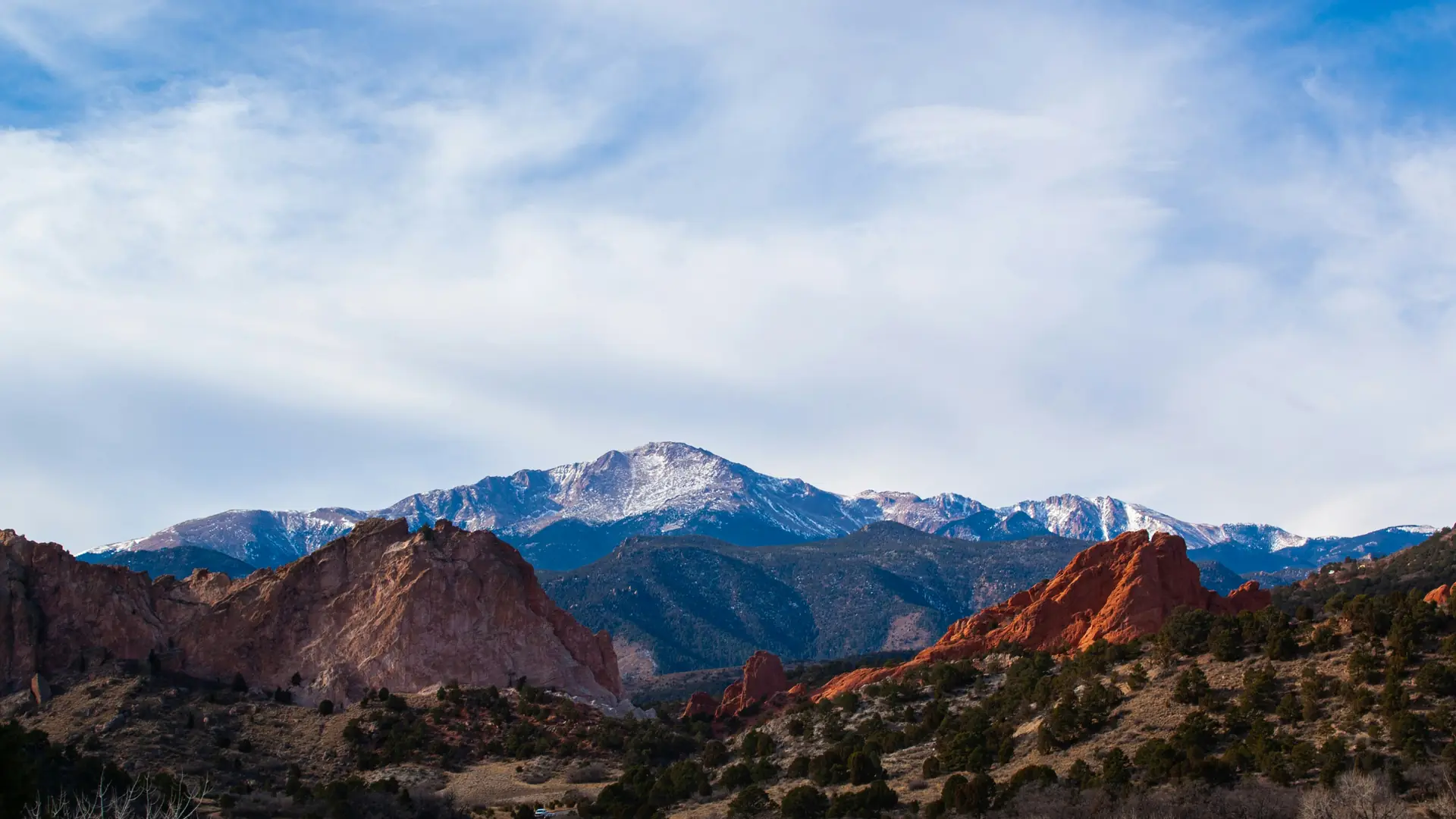
Denver's Cherry Creek and South Platte trails link the city to the suburbs car-free, and the Peak to Peak Highway between Boulder and Estes Park is the classic foothills road. Boulder riders climb Flagstaff and Lefthand Canyon. In Colorado Springs, Garden of the Gods' paved loop under the red rocks, the Pikes Peak Greenway, and the gravel of the Rampart Range are minutes from downtown, and the Pikes Peak Highway climbs to 14,115 feet.
Where is the mountain biking in Colorado?
Crested Butte, Fruita, and Durango are the three pilgrimage towns; Monarch Crest and the 401 Trail are the alpine rides, and the Colorado Trail runs 500 miles from Denver to Durango for bikepackers. Class 1 e-mountain bikes are allowed on many Colorado Parks and Wildlife and Forest Service trails, but access is decided trail by trail, so check the posted rules before you ride.
Which Colorado events should be on the calendar?
The Triple Bypass in July crosses three passes and 10,000 feet of climbing between Evergreen and Avon. SBT GRVL in Steamboat Springs in August is the marquee gravel race, the Copper Triangle in early August loops Fremont, Tennessee, and Vail passes, and Ride the Rockies tours the state over a week each June. The Pikes Peak Cycling Hill Climb in Colorado Springs settles who can climb 7,800 feet in 12.4 miles.
When is cycling season in Colorado?
The Front Range rides most of the year thanks to 300 days of sun, with winter days warm enough between storms. The high passes open from late May or June through September or early October, when the first snows close them again. Afternoon thunderstorms are a summer certainty above timberline, so start early, and the altitude means hydrating more and expecting less power than at sea level.
Law summaries are current as of October 2026 and are not legal advice; see the Colorado e-bike and bicycle laws page for statutes. Trail and event details change; check the organizer or land manager before you go.